Tree Removal Spokane: Big Trees Come Down in Sections, Not Gambles
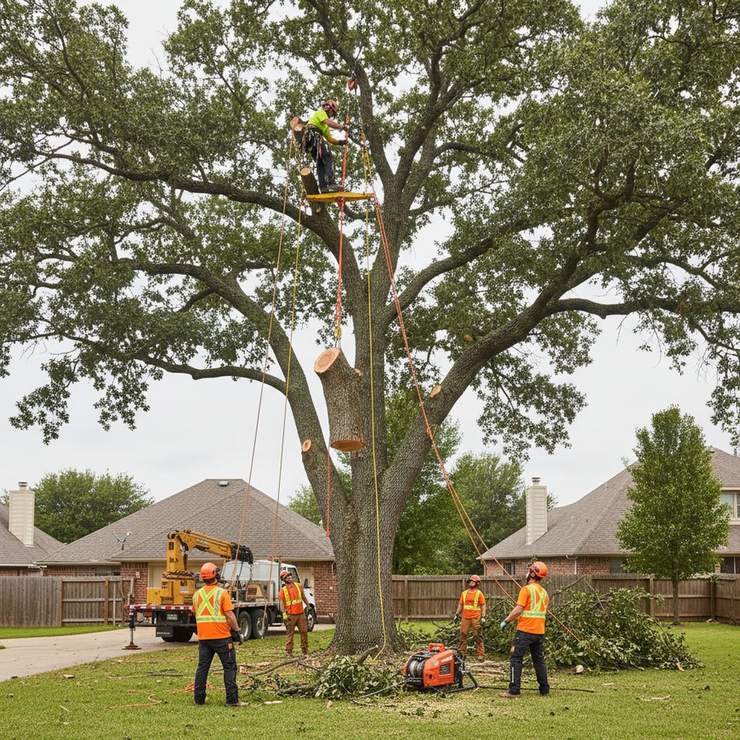
Read the lean. Set the rigging. Lower every piece into a clear drop zone, then rake the yard clean. It starts with a free written estimate.
Why Does a Big Tree Come Down in Sections?
Somewhere on your lot there is a tree that has outgrown its welcome, and the real question is not whether it can come down, it is how it comes down without touching anything you care about. Our licensed, bonded, and insured crew removes trees of every size across Spokane and Spokane Valley, hauls away every branch, and starts with a free written estimate.
- Sectional takedowns over houses, garages, fences, and Avista lines
- Crews who know Spokane's trees, ponderosa, cottonwood, fir, aspen, birch, and how each one carries its weight
- Lawns, beds, and driveways protected before the first cut is made
- A written price in your hand before anyone climbs
- Free estimates from a licensed, bonded, and insured local crew
Every takedown starts with the same three questions: where does the tree want to go, where can it be allowed to go, and what sits in between. A mature ponderosa towering over a ranch home can hold ten tons of wood ninety feet in the air, and the failure points that matter, heart rot in the trunk, an old lightning seam, roots losing their grip on a slope, hide where nobody can see them from the driveway. So the crew reads the lean, picks the rigging points, and takes the tree apart from the top down, each section cut, held on rope, and lowered into a clear drop zone. One tree becomes a hundred small, controlled decisions instead of a single irreversible one.
Spokane's species mix keeps the work honest. Ponderosa pine owns the hillsides, the South Hill, the bluffs above Latah Creek, the pine lots up toward Mead, and its heavy, high crown calls for aerial work. Cottonwood along the river and the low Valley ground grows fast, turns brittle, and tops the list after every windstorm. The old maples shading the South Hill and the century street trees of Browne's Addition shed heavy limbs of their own, while the spruce, fir, birch, and aspen through Kendall Yards and the newer plats each balance differently on the saw. No two removals get the same plan, because no two trees carry their weight the same way.
Most of our removal calls trace straight back to Spokane weather. The west winds that rake the region a few times each fall, and the ice load of a hard January, find every weak fork and hidden crack at once. The slower troubles, pine beetle, root rot, a drought-stressed crown thinning season by season, give more warning but end at the same place. And on the slope properties along Latah Creek and Hangman Valley, saturated spring ground can loosen a root plate until a tall pine starts leaning where it never leaned before.
Spokane Tree Pros works these streets, not a territory drawn on somebody else's map. The crew knows the rocky hillside soils, the shoreline rules out at Liberty Lake, and which city-of-Spokane removals brush up against the heritage-tree ordinances. You get a clear scope, a written price before the first cut, and a raked yard when it is over, in Spokane, Spokane Valley, Liberty Lake, Mead, Cheney, and the communities around them.
And if the tree can be saved, you will hear that first. Plenty of rough-looking trees just need weight taken off the right limbs, see our tree trimming services in Spokane, or read the full breakdown of removal vs. trimming signs. If you want to walk the tree yourself first, the signs a tree needs removal guide tells you what to look for, and if it stands in the strip along the street, check the Spokane tree permit rules before anything comes down. When removal genuinely is the safer call, we will say that plainly too.
How a Removal Actually Runs
Most Spokane removals finish in half a day to a day. A big pine pinched behind a hillside fence takes longer than the same pine standing in open Valley lawn, because control takes time. Here is what happens between your first call and the last pass of the rake.
Free Assessment
An arborist walks the lot with you, reads the lean and the crown weight, measures how close the tree sits to the house, the fence, and the nearest line, and works out whether equipment can reach it or the wood comes out by hand. You get a written price on the spot, free, with no push to book that afternoon.
Rigging Plan & Setup
The crew arrives with what your tree calls for: a bucket lift for tall open pines, climbing gear and lowering lines for the tight backyards of Spokane's older grid, a chipper for the brush. Drop zones get walked and flagged, mats go down on soft spring lawns, and beds, sprinklers, and driveways are accounted for before a saw starts.
Controlled Takedown
Near a structure, the tree comes down from the top in sections, each piece held on rope and eased into the drop zone rather than dropped. An open Cheney or Valley lot with room to work may allow a planned directional fell instead, with the hinge doing the steering. The site decides the method, never the clock.
Full Cleanup
Brush is chipped, wood and grindings hauled, and the lawn raked until the only sign of the day's work is the missing tree. Want firewood out of that ponderosa or fir? Say so before we start and the trunk gets bucked and stacked. Stump grinding can ride along on the same visit so you are not booking a second crew.
What Tree Removal Costs in Spokane
No two trees price the same, because no two trees present the same problem. Height, trunk diameter, what sits inside the drop zone, whether a truck can reach the work or a climber has to, and how many trees come out in one visit all move the number. The ranges below cover typical residential jobs around Spokane.
| Tree Size | How Pricing Works |
|---|---|
| Small trees (under 30 ft) | Free estimate, priced on-site |
| Medium trees (30 to 60 ft) | Free estimate, priced on-site |
| Large trees (60 to 80 ft) | Free estimate, priced on-site |
| Very large trees (80 ft or taller) | Free estimate, priced on-site |
| Stump grinding (add-on) | Free estimate, priced on-site |
The single biggest cost driver is what the tree could hit. A pine with open lawn on every side is a straightforward directional fell; the same pine over a roofline is a top-down dismantle with every section rigged and lowered, and that kind of control takes hours. A hard lean, hidden rot that changes how the wood can be cut, and hand-only access add rigging time too.
Stump grinding is priced separately from the removal itself, depending on the diameter and how the roots run, and it is easiest to add while the crew and grinder are already on your property.
The only accurate price is one written on your own lot. The crew walks it with you, explains the plan for your specific tree, and hands you a free written estimate on the spot, with no obligation attached. Call or text (509) 632-4080 to set up your free estimate over the phone.
When a Tree Needs to Come Down, and When It Doesn't
Removal is the last tool in the box, not the first. Plenty of rough-looking trees can be kept with pruning, cabling, or plain patience. But some signs mean the structure itself is failing, and once structure goes, the only question left is whether the tree comes down on your schedule or the weather's.
- The tree is dead, or more than half the canopy has gone over to dead wood
- Mushrooms or shelf fungus at the base or on the trunk, the visible edge of rot working through the wood
- A lean toward the house, driveway, or a power line that has visibly worsened
- A trunk or major scaffold limbs cracked by storm, lightning, or nearby construction
- Disease or insects, pine beetle chief among them here, past the point of recovery
- Roots cut or crushed by construction, paving, or excavation that have loosened the tree's anchor
- A tree pressing hard against a structure or starving healthier trees of light
- Roots heaving the driveway, lifting the sidewalk, or probing at the foundation
If you are not sure which side of the line your tree sits on, that is exactly what the free assessment is for. The crew will tell you plainly whether it can be kept or should come down, and in Spokane the calendar matters: a borderline tree in September can become an emergency in the first hard November wind. Sorting it out early is safer, and usually cheaper, than letting the weather decide.
Storm-Damaged & Hazardous Tree Removal in Spokane & Spokane Valley
Spokane's worst tree weather comes in two flavors: the west-wind storms that roll in off the basin a few times each fall, and the quiet ice events that add hundreds of pounds of load to every limb overnight. Ponderosa carries its weight high, so a gust that a low, round South Hill maple shrugs off can snap a pine top clean or peel a cottonwood down its main stem. That is how a tree that looked fine on Friday ends up across the driveway Saturday morning.
When that happens, hazard calls are worked ahead of the routine schedule, and a crew gets rolling as soon as conditions let it work safely. A trunk resting on the roof, a cracked leader hanging over the bedroom, a tree pinning the only way out of the driveway, those do not wait their turn behind scheduled pruning jobs.
If the damage is headed for a homeowners insurance claim, we document as we go, detailed invoices plus photos of the damage and the removal work, so your adjuster has what they need.
What earns hazard priority? A tree partially down on a structure and still under tension. A broken limb hung up over a walkway or a spot where people pass. A tree shoved into a fresh lean by saturated ground. Anything fallen across a driveway or road. If you are not sure your situation qualifies, call and describe what you are seeing, you will get a straight answer, not a sales pitch.
Dealing With a Hazard Tree Right Now?
Storm and hazard calls get priority attention. Call (509) 632-4080 and we will tell you honestly what the schedule looks like.
Tree Removal Questions, Answered Straight
How much does tree removal cost in Spokane WA?
Is tree removal dangerous?
Do you remove tree stumps after cutting down a tree?
How long does it take to remove a large tree?
Will you clean up after removing the tree?
Will you damage my lawn or landscaping during removal?
Can you remove a tree near power lines?
What equipment do you use for tree removal?
Do I need a permit to remove a tree in Spokane?
Is the price higher for trees close to a house?
Do you handle storm-damaged and hazardous trees in Spokane?
Should this tree be removed, or can trimming fix it?
Can you remove a tree in my backyard with limited access?
What happens to the wood chips after tree removal?
Do you service the entire Spokane metro area?
How do I schedule a tree removal?
Contact Spokane Tree Pros
Start with a free written estimate
Call and it lands with your local Spokane crew. Free estimate, fast. No forms, no obligation.
Call (509) 632-4080Free estimate over the phone Estimate Your Job in 30 SecondsSize up your job on the home pageFree estimate. No obligation.